You Can Still Call Me Doctor

I’m still called an admiral / Yet I gave up the sea long ago. Tim Rice, Evita

With barely any notice, I went through a significant transition at the end of July. My Illinois medical license, something I have cherished for almost 50 years, expired. I made no attempt to renew it.

It wasn’t the minimal fee that kept me from renewing. It was my lack of the necessary continuing medical education hours. When I renewed the license the first time after retirement, I still had more than enough allowable hours from my working days to meet the requirement. But for the last three years, I have barely dipped into a pathology journal, attended a conference, or attempted an online course.

A friend suggested applying anyway, and just “creating” some CME hours. “No one will catch you,” he said. Of course, that’s not me. I wouldn’t do that, equal parts moral compass and fear of being discovered. Besides the point of all those hours isn’t just to list them on a data sheet, but to keep current with my profession, so as not to be using an abacus in an AI world. Molecular pathology, barely budding when I left the field, is now in full bloom. Unless you’ve been a constant gardener, reading, watching, and using, there is no way to keep up.

Would there be any benefit to me in maintaining my license? None that I can think of. I already turn down the monthly calls from locum tenens companies seeking a temporary pathologist for this lab in Idaho or that one in Maine. The companies I once thought I would do remote digital pathology for seem to have crashed and burned, or at least discovered that they didn’t need me. I won’t be able to prescribe an antibiotic for Barb or for a grandkid, but I never did much of that anyway.

So my Illinois license is a thing of the past, alongside ones from Indiana and Wisconsin. But you can still call me a doctor. That came with a degree that will never expire, no matter how long it’s been since I went to sea.

The Story Is My Eyes

“Does that bother you?” Dr. Counter, my optometrist, was completing my annual eye exam and pointing at my droopy right eyelid. I told her I knew about it, but didn’t pay it any attention. I relayed that my dad had the same malady. He had ignored his languid lid too.

“You have a condition called ptosis. Your drooping eyelid is blocking your pupil,” Dr. Counter continued. “It could affect your eyesight, particularly your peripheral vision. You should see Dr. Press, our ophthalmologic orbital surgeon for a consultation.”

At first, I resisted the idea. I was convinced that my eyesight issues were due to progressing presbyopia and incipient cataracts. What did my eyelids have to do with that?

But after a few days and a gentle nudge from Barb, I reconsidered. There was no harm in having a specialist assess me, so I made an appointment with Dr. Press. Her first opening was in the middle of September but when another patient canceled their scheduled visit, her staff moved my slot to last Thursday morning. I had to drop out of an anticipated pickleball match to get to the appointment. C’est la vie!

The visit to Dr. Press’s office began with “field of vision” testing to see if my peripheral vision was intact. If you have ever had this done, you know the testing is usually pretty crude. The tech or doctor moves two fingers around the edges of your vision and asks if you can see them. That is all that is necessary in most circumstances.

The testing in Dr. Press’s office was more sophisticated. Under the guidance of a pair of techs, I stared into a binocular device and clicked a buzzer (Jeopardy! appearance flashback) whenever I saw a light flash at the very edge of my vision. The process was repeated with my eyelids taped open.

After the tests were complete, Barb and I were introduced to Dr. Press, an engaging young woman somewhere between our daughter and our granddaughter in age. During introductory chit-chat, we discovered that she grew up in the subdivision we now live in. That felt like good Karma.

Dr. Press examined me and then made her pronouncement. “I’m looking at the field of vision test data and your eyes. You have bilateral ptosis. Weakened eyelid muscles are the culprit. Our testing confirms that the droop affects your vision, so surgery is advisable. I can make a small incision into the underside of each lid and tighten the muscles, leaving the eyelids more elevated. It’s outpatient surgery with minimal risk and a quick recovery.”

“Surgery for weak muscles?” I wondered. “What happened to exercise and spinach?” But it is doubtful incessant blinking will bulk up my eyelid muscles, and I prefer kale to spinach. If surgery is the best way to improve my vision, I’ll go under the knife with Dr. Press, my Doc from my Block. When it’s all over I’ll see better–and look better too. I’m all in on that Daily Double.

And to my pickleball friends, sorry I dropped out of last week’s match, but wait until you see me after surgery. You’ll all want to be my partner. It’s going to be a whole new game!


You can also join my Facebook Page

Scalpels to Stage Plays: Autopsies, Case Studies, and Blogging Adventures

Long ago I lost count of the number of blogs I have posted in the last nine years. My best estimate would be that it has been about 700 times that I have asked you to spend a few moments with me. But before I became a blogger, writing for pleasure (mine, if not yours,) I wrote a few articles published in medical journals–not enough articles for me to be considered an academic, but enough to have multiple mentions in Index Medicus, the Yellow Pages of medical articles in reputable journals.

What was I writing about? Much like my current blogs, every scientific paper was different from the last, with a different focus and frequently intended for a different audience. My earliest papers were predominantly case studies, reporting interesting and/or previously undescribed phenomena I encountered while doing my first 100 autopsies as a pathology resident. One of the papers integrated in-utero radiographic findings with autopsy findings in a condition known as polysplenia1. A second case 2 involved detective work à la Quincy, as a colleague and I traced a patient’s history to determine the source of a triangular portion of plastic in their stomach that had caused fatal blood loss. Our investigation and publication earned us our hospital’s Resident Research of the Year award–scant consolation to the family of the deceased.

While still in my residency, my next published paper dealt with the use of frozen sections on needle biopsies of the breast for the diagnosis of breast cancer 3. My paper, based on a series of cases at my hospital, took a position against this practice. This was significant in an era when a malignant diagnosis on a frozen section of a breast biopsy was frequently followed by a modified radical mastectomy. After the paper’s publication a nationally known pathologist asked me to contribute a chapter to his forthcoming book on breast pathology. In a major career faux pas, I passed on the opportunity.

As my residency closed, I was asked to contribute a thought piece to another national journal, discussing the future of pathology 4. 45 years later I don’t remember what I saw in my crystal ball, although I know I failed to predict the world of genomics, digitization, and artificial intelligence, all of which have revolutionized pathology.

Once in my career as a community hospital jack-of-all-trades pathologist, my paper writing tapered off significantly. A short piece on urine cultures 5 (fun stuff) was followed many years later by a detailed description of a simple inking technique to prevent mix-ups of biopsy specimens in the lab 6. Significant in its time, that method is now out-moded with the easy availability of bar-coding and DNA analysis to confirm specimen identity.

Throughout my career, the laboratory data I have provided has been used in countless conference presentations, abstracts, and journal publications. While my name appears on many of those, I don’t feel much personal connection with them. My hands weren’t on the keyboard or posterboard.

In retirement, my medical writing days are past–almost. My as-yet-unproduced play does have a medical aspect. As the saying goes, write what you know, and know what you write. So far, it has worked for me.


For those of you who are curious:

  • 1 Arch Pathol Lab Med. 107:202-203, 1983
  • 2 Southern Medical Journal. 74:900-901, 1981
  • 3 Breast. 8:11-13, 1982
  • 4 Pathologist. 37:1983
  • 5 Laboratory Medicine.1985
  • 6 Arch Pathol Lab Med. 2009;133:295-297

“Do We Know Doug Rhone?”

“Babe, do we know anyone named Doug Rhone?” Barb asked me as she got out of bed this morning. “I was having weird dreams again. Jews were being rounded up and a man named Doug Rhone was telling us to escape to Texas or Canada.”

During this current spate of antisemitism, having a nightmare of Jews being rounded up, although tragic, is easily explainable. The more startling part of Barb’s dream to me was her mention of Doug Rhone. I did once know Doug, but Barb had never met him. Through the strange workings of the subconscious, Barb had brought up a name she had probably not heard in more than 40 years.

I first met Doug in 1976, when I was a 2nd-year medical student at the University of Illinois in Chicago. With a class of over 400 students, many of us were exiled to surrounding community hospitals for our 3-month long course in pathology. I was assigned to Illinois Masonic Medical Center in the Lake View neighborhood. Our handful of instructors were led by Dr. Douglas Rhone, the new Chairman of Pathology at Masonic.

The students were a rowdy bunch; most of us had no interest in pathology and were more interested in our simultaneous P-Dog (physical diagnosis) lectures and our first experiences examining patients. It would have been hard to predict that two of us would wind up as pathologists.

But by the time my third year of school rolled around, I had chosen pathology as a career. I spent a month doing an elective rotation in the lab at Masonic, as well as months at Northwestern Memorial and Evanston Hospital.

When it came time to rank hospitals for our upcoming residency training, I opted to put Evanston at the top of my list and I landed there on the notorious “Match Day,” the day when medical students around the country learn where their internships and residencies will be. I told Dr. Rhone my decision, and while he was disappointed with my choice, he made me promise to look him up in four years when my residency would end and I would be looking for a permanent position.

It only took three years until Illinois Masonic needed an additional pathologist. Dr. Rhone selected someone from my program at Evanston who was completing his residency a year before me. When I finished my residency the next year I contacted Dr. Rhone, but he told me there were no positions in his department. I wound up practicing at a suburban Chicago hospital.

I had no more opportunities to speak with Dr. Rhone since that day in 1982. In truth, I rarely thought of him. A brief survey of the Internet shows that he passed away in 2011, a death I was not aware of.

You can imagine how stunned I was to hear Barb ask her question this morning. How was it that her brain had held on to Doug Rhone’s name and it appeared in a dream more than 40 years after she had last heard it? The future may be the era of artificial intelligence, but can that ever be as complex, as surprising, or as astounding as our own minds at work?


Ever Regret Something You Have Done As Part Of Your Job? I Do.

Sometimes an unexpected encounter can lead down memory lane. And not all memories are ones to be proud of.

Barb and I were walking through the parking lot of Charlie Beimlich’s Food and Tap, our not-quite-a-dive-bar go-to place when we are in the mood for a juicy burger. In the evening gloaming, I very briefly saw a couple walking ahead of us and mentioned to Barb that the pair looked like Aaron and Ruth Reynold, two fellow physicians that I hadn’t seen in years.

As Barb and I were led to our seats I glanced at each of the dozen tables in the restaurant but didn’t see the other couple. We ordered our burgers and distracted by the food and the Bulls’ play-in game on the restaurant TV, I forgot all about the possible sighting.

But as we were leaving, I took a look at the people sitting at the bar and convinced myself that Aaron and Ruth were seated there and were just finishing their meal. I walked up to the couple at the bar, tapped Ruth on the shoulder, and said hello. She looked surprised at first, but then recognized me and smiled her own greeting.

Barb joined us and after a brief reintroduction, Ruth, who was a former community pathologist like me, and Aaron, an internist, compared notes on our recent retirements, pickleball, grandkids, and the attraction of Florida. I reminded Aaron that we had been medical school classmates, the Class of 1979.

And as I drove home, I remembered a little bit more. Aaron and I had not just been classmates. We had both spent the summer between our M1 and M2 years as junior researchers in the lab of one of our professors, an Eastern European scientist studying the pharmacology of sleep.

I didn’t have a car that summer, so every day I would board the El at the Morse Ave stop and ride into the city. A long walk through an underground tunnel connected me to the train going west and in a few minutes, I was at the medical campus and the lab. That voyage prepared me for what was to come each day.

I had been assigned to a post-doc and together we perfected an assay to measure a chemical linked to sleep. That was fine. It was the other half of my duties that I now regret. Our subjects were cats. I won’t describe how we obtained our feline material for testing, but I assure you it was regrettably cruel, and would be wholly unacceptable today, and should have been then, too.

My most horrifying moment was when a cat I was working with escaped and ran into the office of the department chairman, a very severe, sharply dressed gentleman who was one of the few African-American professors in the medical school. I don’t know who was more frightened, the professor or the cat. That was the last live subject I handled in the lab.

The summer ended soon after that. I cashed my $1000 stipend and buried thoughts of those poor kittens. I never discussed the summer with Aaron, but our chance encounter at a hamburger bar brought it all back to me.

I wasn’t much of a friend to those kittens in the summer of 1976. I think I will give our cat some extra catnip tonight and donate to a pet shelter in the morning. It is the right thing to do.


Hey! Can you do me a favor? If you are a subscriber and enjoy my blogs, please email them to friends and contacts. And if you read my blogs on Facebook, please share them! We are always looking for new readers.

In Memory of Lin Brehmer and Dr. Rebecca Blank. After Every Loss We Must Fight For More Wins. Please Read To The End.

Last July, my post was centered around the newly public cancer diagnoses of Lin Brehmer and Rebecca Blank. As everyone in Chicagoland knows, Lin, our local WXRT radio legend, succumbed to prostate cancer last month. This week, we learned that Dr. Blank, the incoming President of Northwestern University, has passed away from her “aggressive” cancer, which I have seen classified as pancreatic cancer.

Sadly, my campaign for a moment of radio silence in honor of Lin fell on deaf ears. Too many readers let me know that “dead air” was the last thing a radio pro like Brehmer would have wanted. My next request will be for NU’s men’s basketball Wildcats to win a few games in the NCAA March Madness Tournament to honor the University President who never got to be. Go Cats!

Prostatic cancer and pancreatic cancer are the two diseases that took my father and my sister. Each year tens of thousands of other Americans die of these two scourges. A thimbleful of DNA gone wrong, a pinpoint of genetic material led astray, and a person’s life and sometimes lifespan is indelibly altered.

I am not an eternal pessimist. All cancer news is not negative. Progress is being made in the multi-faceted battle against the disease. The very genes whose alterations begin the malignant process are now targets for therapies that can halt or reverse the course of the disease. Surgery and radiation treatments have become more focused in an attempt to minimize patient side effects and avoid damage to surrounding tissues. In fact, better treatment along with earlier diagnoses and a decrease in smoking rates have given us a remarkable 33% drop in cancer death rates over the last 30 years.

My friends with cancer histories are fighting strong and proud. This week I bowled with a prostate cancer survivor and played tennis with a kidney cancer warrior. I aspire to play half as well and be half as optimistic as either one of them. And my dear wife is 11 years past her melanoma diagnosis and treatment. I look forward to a day when all cancer patients can celebrate the same successes.

Those of you who know me well are aware that for many years I have been involved in the SEA Blue/Zero Prostate Cancer Walk and Run for Prostate Cancer Awareness. My involvement continues this year. If you are thinking of Lin or someone in your family who has been affected by prostate cancer and want to help prostate cancer patients please support our cause by clicking this link. (Please be aware the donation process currently only works from mobile phones. It does not work on desktop computers or tablets.) Any and all donations are appreciated.

And if you are a Northwestern alum and want to recognize Dr. Blank, a memorial fund exists at the University of Wisconsin, where she served as Chancellor for nine years.

The fight goes on!

A Lingering Odor Brings Back Memories

The Anatomy Lesson, a 1632 oil by Rembrandt.

I needed to review a bit of anatomy to accurately describe and analyze a complex surgical specimen I had received in the lab. I opened the farthest cabinet in my office and pulled out a slim green volume that I had not touched in years, “ANATOMY A Regional Atlas of the Human Body” by Carmine D. Clemente.

And before I could even open the book I was carried away. The lingering odor of formaldehyde hiding the scent of slight decay filled my nostrils. I was immediately back at the University of Illinois Medical School in Chicago, a very young and raw first-year medical student, riding the elevator to another anatomy dissection.

Prior to medical school, I was ignorant and relatively uninterested in the interiors of the human body. Most of what I knew came from playing the game “Operation,” removing funny bones and Adams Apples while trying not to set off the electro-probe buzzer. If I knew my heart was on the left side of my body, it was only because I was used to placing my hand over it while saying the “Pledge of Allegiance.” It was pretty clear I was not headed for life as a surgeon.

But the anatomy lab was a fascinating place. The elevators took the 400 of us in my class to an enormous room with row upon row of elevated rectangular metal boxes. Within each was a human cadaver, semi-embalmed, semi-decaying. As part of a team of four, I was assigned a corpse, and given nine months to learn what had made her tick.

My squad had a mixed background: Nina, a short-bubbly brunette from the East Coast, Dwight, a downstater from Effingham, Tom from the outer ring of Chicago suburbs, and myself. We showed up for each session in our lab coats and reusable rubber gloves — only the lucky few in our class had access to disposables. In our pockets were small dissection kits in black plastic wallets; scalpels, tiny scissors, a set of forceps. And in my hand, the anatomy atlas, soaking up the odor of the room as I tried to soak up the knowledge.

Our lab section met two times a week. In each session we would focus on a different part of the body: one day dissecting out muscles, tendons, nerves, and arteries from an arm, then a few weeks later analyzing the chambers, valves, and vessels of the heart. Proctors roamed past the metal tanks, answering questions and making morbid comments.

We were expected to learn the position, name, and function of each item we came across. Every few weeks we had a practical exam, each student walking from cadaver to cadaver to identify structures that had been marked by the proctors with a snip of twine. Many times the twine was thicker than the tiny nerve we were asked to identify.

It was a privilege to have had the opportunity to examine, dissect, and come to know those bodies. I do hope I have honored that privilege throughout my career. I’ll always treasure my green anatomy atlas–for the memories and the scent of those earlier days.

Filling My ARC

A few days ago the morning news mentioned that there were 74 days left until Christmas. Doing some simple math, I determined that meant there were 80 days left until my retirement.

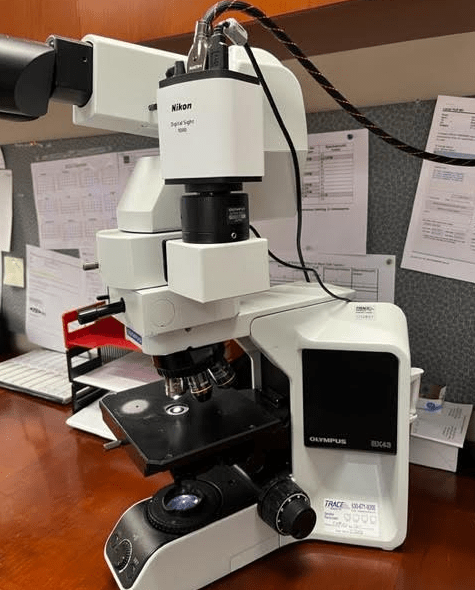
The nearness of Retirement Day to Christmas Day got me thinking–if I had an Advent Retirement Calendar (ARC), what would it look like? What would be behind each of the 80 doors that I would open before I turn off my Olympus BX43 microscope for the last time?

I am sure the first few doors would open up to my education. Doors for an undergraduate curriculum balancing STEM courses I survived (physics, quadratic equations, quantum mechanics) with literature courses I loved (Russian Lit, Female Writers of the 20th Century, The British Novel.)

Flip open some doors for the four years of medical school. The first year when all I learned in those tough undergrad science courses put me at the top of the class; the next three years when I discovered that patient care wasn’t for me, but that I might find my way as a pathologist.

Night school gets its own door as I left Barb with two young kids, two nights a week, so I could study for my MBA. I came away with a diploma, an award, and some finance and management concepts to help guide me. Barb survived as well.

So many doors to open for my 22 years at a community hospital, climbing the ladder until the floor underneath disappeared and the whole thing toppled. A door for my mentor from whom I learned what to do and how to not behave while doing it. A door for my associate there, whose T-shirt read “Though Shalt Not Hassle.” A door or two for the “academic” pathology group that first embraced me and then discarded me while assuring me it was nothing personal.

Many more doors for my next step, the lab that I built from nothing more than a notion in some urologist’s minds, modeling it after all I had known before. Doors for the business consultants and the early believers who got the engine running, and more doors for all who climbed aboard the train as we chugged along to excellence. The riders on that locomotive knew my real door, the door to my office, was always open.

Doors for all the inspections I endured at my lab, and all the inspections I inflicted on other labs. Hopefully, things were learned by all parties along the way.

Doors for my lab companions who passed away during our shared careers and have never left my mind: Earl, Ramji, and Al at my first stop, Cindy and Paul at my second. You have all been missed.

Doors for the cherished automobiles I powered down the tollway — perhaps a quarter of a million miles since 2005.

And of course doors for my family and friends who were always with me and supportive, through busy days and sleepless nights.

I trust I have filled up my ARC. And I trust whatever lies ahead will be just as amazing.

Lights at the End of the Tunnel. Of Moon Shots and Medicine.

As I glanced through the obituaries the other day (yes, I have reached that stage in my life) I noticed a death notice with funeral arrangements for an oncologist I worked with twenty years ago. Of course I was saddened to hear of his passing, but what immediately came to mind was a conversation with a different oncologist that I overheard a long, long time ago–1976, to be precise.

It was the very beginning of my 2nd year at the University of Illinois School of Medicine. M1 Year had been spent buried in textbooks and anatomy lab, but with the onset of M2 Year, our class had (very limited) entre into the clinical world.

We were placed in groups of four, and each week every group had a pair of three-hour sessions in a clinician’s office. My group’s assigned physician was a busy oncologist who tolerated our being in his office but didn’t let us do much with his patients, and didn’t offer much insight either. But at least we got the vibe of being in the same general vicinity as living, breathing, patients.

At the end of one Tuesday session, our oncologist told us not to show up for that week’s Thursday session, as the office would be closed while he attended a funeral.

“Do you go to all your patient’s funerals?” the boldest of our foursome of M2s asked.

“I don’t go to ANY of them,” was the rather brusque reply.

A couple of that oncologist’s attitudes were transmitted to us in that brief exchange. “First,” he was conveying to us, “as a physician, you must keep your distance from your patients. Medicine is your occupation, maybe even your passion, but the patients are not your friends.”

“Second,” he seemed to be saying “I am an oncologist. All my patients die.”

As I said, that was a long, long time ago. I followed my talents to a medical field where I have so little patient contact that there is little risk of patients becoming my friends. Instead many of my friends have become my “patients”, the downside of being a 60-something prostate pathologist with a cadre of friends my own age.

But more importantly, oncologists no longer need to feel that their patients will die from their disease. Tumor screening (colonoscopy, mammography), leading to early cancer diagnosis, the use of genetic evaluation of tumors to guide therapy, the fantastic advances in understanding tumor immunology-these are wondrous tools that have made many cancers curable or converted them to chronic, treatable, conditions rather than rapidly lethal nightmares.

We aren’t at cancer nirvana yet. Treatments are still too expensive, life-style factors still put patients at risk. Some malignancies still baffle the best experts.

But perhaps in my lifetime, the Cancer Moonshot will succeed. And when an oncologist says “I don’t go to cancer patient’s funerals” it will be because there are none.


Like what you read here? Add your name to our subscription list below. No spam, I promise! ___

#mc_embed_signup{background:#fff; clear:left; font:14px Helvetica,Arial,sans-serif; }
/* Add your own MailChimp form style overrides in your site stylesheet or in this style block.
We recommend moving this block and the preceding CSS link to the HEAD of your HTML file. */

Subscribe to our mailing list

* indicates required
Email Address *
First Name
Last Name
//s3.amazonaws.com/downloads.mailchimp.com/js/mc-validate.js(function($) {window.fnames = new Array(); window.ftypes = new Array();fnames[0]=’EMAIL’;ftypes[0]=’email’;fnames[1]=’FNAME’;ftypes[1]=’text’;fnames[2]=’LNAME’;ftypes[2]=’text’;}(jQuery));var $mcj = jQuery.noConflict(true); ———————————–

We Save Lives (and I Apologize)

Photo courtesy Chicago Tribune

Words have an impact. Whether the speaker is a politician, an entertainer, or a blogger, they must think about the words they choose–and choose carefully. I try to do that, but despite my scrupulous care, I made a blunder in my word choices in a previous blog and I want to apologize for it.

You may recall my last posting conveyed some thoughts on my profession, ranging from Sherlock Holmes to surgeon’s “fingerprints. And in a section dealing with statistics, I said “Some days every prostate I look at will be malignant and I feel like Dr. Death.”

I really should have known better. Within a few hours of posting, I received the following from Marty, a friend, and prostate cancer warrior:

What? 


No, no.  Better to realize you are giving these men (myself included!) a 2nd chance at life as they and their doctors learn that they now need to enter the “treatment phase” of their now discovered prostate cancer.  

And B’ruch HaShem may that treatment extend their lives for many productive years to come!
 

We MUST stay positive.

Marty was so right. The diagnosis of prostate cancer is absolutely not a death sentence. By far, most men diagnosed with prostatic cancer will live long and fruitful lives, enjoying careers, family, and free time.

So instead of referring to myself as Dr. Death, I should have chosen an honorific like Dr. Decision Tree (I know, I know, it doesn’t have much zing.) My diagnosis is a key piece of the data set that guides the patient and his medical team as to whether to treat (surgery, radiation, hormonal modulation, immunotherapy) or not to treat (active surveillance) the patient’s cancer.

(And while we are talking about prostate cancer, here is my annual plug for PSA testing. Ask your physician if it is right for you and the men in your life.)

Marty, you have improved my mindset. I will watch my words with the focus of a laser beam. You reminded me that, as one of my previous partners used to say, “We are pathologists. We save lives!”


#mc_embed_signup{background:#fff; clear:left; font:14px Helvetica,Arial,sans-serif; }
/* Add your own MailChimp form style overrides in your site stylesheet or in this style block.
We recommend moving this block and the preceding CSS link to the HEAD of your HTML file. */

Subscribe to our mailing list

* indicates required
Email Address *
First Name
Last Name
//s3.amazonaws.com/downloads.mailchimp.com/js/mc-validate.js(function($) {window.fnames = new Array(); window.ftypes = new Array();fnames[0]=’EMAIL’;ftypes[0]=’email’;fnames[1]=’FNAME’;ftypes[1]=’text’;fnames[2]=’LNAME’;ftypes[2]=’text’;}(jQuery));var $mcj = jQuery.noConflict(true); ———————————–